Francophone Mobility Work Permit (C16)
Francophone Mobility is an LMIA-exempt work permit that lets French-speaking workers take a job with an employer outside Quebec, at any skill level, without the employer needing a Labour Market Impact Assessment.
What Is the Francophone Mobility Work Permit?
Francophone Mobility (Mobilité Francophone) is a stream of Canada’s International Mobility Program, identified by exemption code C16. It allows employers outside Quebec to hire French-speaking foreign workers without going through the LMIA process, provided the applicant can demonstrate intermediate French language ability.
The program is open to French speakers from any country of citizenship. It is not limited to nationals of France, Belgium, Switzerland, or other traditionally French-speaking nations — applicants from Francophone Africa, the Caribbean, the Middle East, and elsewhere who speak French at the required level and have a qualifying job offer can also apply.
At Immisa Immigration, we help employers structure a compliant Francophone Mobility offer through the Employer Portal, and help applicants document their French proficiency and prepare a strong work permit application.
What Counts as "French-Speaking" for This Program?
There is no mandatory language test for Francophone Mobility, but applicants must be able to demonstrate they can speak and listen in French at an intermediate level, generally benchmarked to NCLC 5 or higher on the Niveaux de compétence linguistique canadiens scale.
The key requirements for this LMIA-exempt stream are:
- Proof can include a French-language test result, French-language education, or prior work experience conducted in French
- The job offer must be for a position outside the province of Quebec
- As of June 2023, the position can be at any skill (TEER) level, not only professional or managerial roles
- The employer must submit the offer through the IRCC Employer Portal using exemption code C16 and pay the employer compliance fee
- There is no restriction on the applicant's country of citizenship — eligibility is based on French ability and the job offer, not nationality
Because eligibility hinges on language evidence rather than a fixed test score, how you document your French ability matters. We help applicants assemble a credible language file before the employer submits the offer.
Who Can Apply For Francophone Mobility
French Speakers Worldwide
Any foreign national who can demonstrate intermediate spoken and listening French, regardless of citizenship or country of residence, may qualify.
Applicants With a Qualifying Job Offer
You need a genuine offer of employment from a Canadian employer located outside Quebec, at any skill level under the current rules.
Employers Hiring Outside Quebec
Canadian employers who want to hire French-speaking talent without an LMIA can use this stream instead of the standard labour-market-tested process.
Step-by-Step Francophone Mobility Process

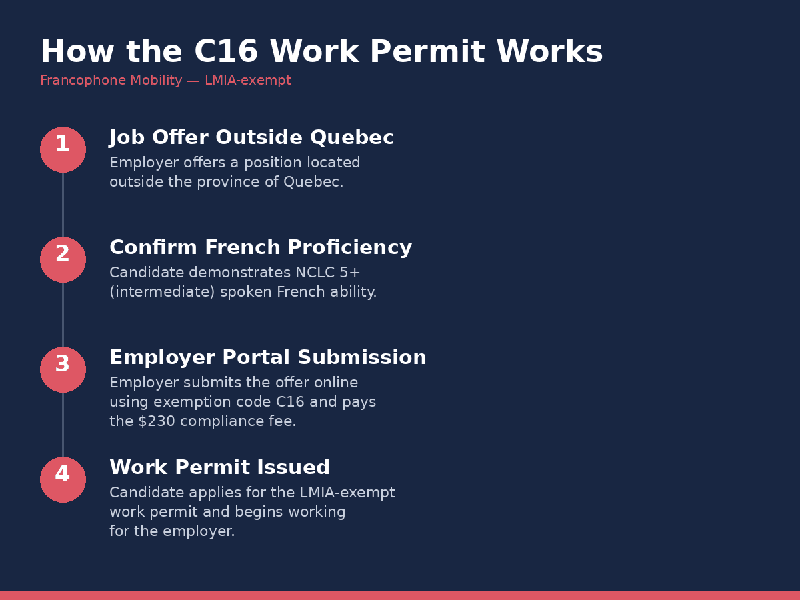
Confirm Language & Role Eligibility
We confirm the applicant can evidence NCLC 5+ French ability and that the position and location qualify for the C16 exemption.
Employer Offer Preparation
The Canadian employer prepares a compliant offer of employment describing the role, wage, and location outside Quebec.
Employer Portal Submission
The employer submits the offer through the IRCC Employer Portal under exemption code C16 and pays the employer compliance fee.
Offer of Employment Number Issued
IRCC issues an offer of employment number, which the applicant needs to apply for the work permit.

Work Permit Application & Language Evidence
The applicant applies for the work permit, including evidence of French proficiency and the employer's offer details.
Biometrics & Processing
Biometrics are completed if required, and the application is processed by IRCC or a visa office.
Work Permit Issued
Once approved, the applicant receives a Francophone Mobility work permit tied to the approved employer and role outside Quebec.
WHY CHOOSE IMMISA For Francophone Mobility?
Language Evidence Strategy
We help you assemble credible proof of French ability, since there is no single mandatory test for this stream.
Employer Portal Guidance
We guide employers through the C16 exemption submission so the offer is structured correctly the first time.
Eligibility Beyond Borders
We help applicants from any country understand whether they qualify, correcting the common misconception that this stream is limited to a handful of nations.
PR Pathway Planning
Canadian work experience gained under Francophone Mobility can support later Express Entry or provincial nominee applications. We help you plan that path from the outset.
Our Approach To Francophone Mobility Applications
Language & Eligibility Review
We assess your French proficiency evidence and confirm the role and location meet program requirements.
Employer Coordination
We work with your Canadian employer to prepare a compliant Employer Portal submission under exemption code C16.
Long-Term Immigration Planning
We connect your Francophone Mobility work permit to broader immigration goals, including permanent residence.
Frequently Asked Questions
What is the Francophone Mobility work permit?
It is an LMIA-exempt work permit (exemption code C16) that lets Canadian employers outside Quebec hire French-speaking foreign workers without a Labour Market Impact Assessment.
Do I need to be from France or another French-speaking country to qualify?
No. Eligibility is based on your ability to speak and listen in French at an intermediate level (NCLC 5+) and having a qualifying job offer — not your country of citizenship. Applicants from Francophone Africa, the Caribbean, and many other regions apply successfully.
Do I need to take a French test?
Not necessarily. You need to demonstrate your French ability through evidence such as a test result, French-language education, or work experience conducted in French. A formal test can strengthen your file but is not always mandatory.
Can the job be located in Quebec?
No. Francophone Mobility specifically applies to jobs outside Quebec. Quebec has its own separate immigration and work permit processes.
What kind of jobs qualify?
As of June 2023, positions at any skill level can qualify, not only professional or managerial roles, as long as the employer and offer meet program requirements.
Can this lead to permanent residence?
Canadian work experience gained through this permit can support future applications, including Express Entry’s Canadian Experience Class or provincial nominee streams that prioritize French-speaking candidates. We can help you map that path.
How is this different from a regular LMIA-based work permit?
The employer does not need to complete a Labour Market Impact Assessment, which is usually the most time-consuming part of hiring a foreign worker. This can significantly speed up hiring, provided the language and location requirements are met.
Ready To Take that First Step ?
Whether you are an employer looking to hire French-speaking talent, or a candidate with strong French skills and a job offer in hand, fill out this short form and our team will get in touch with you!